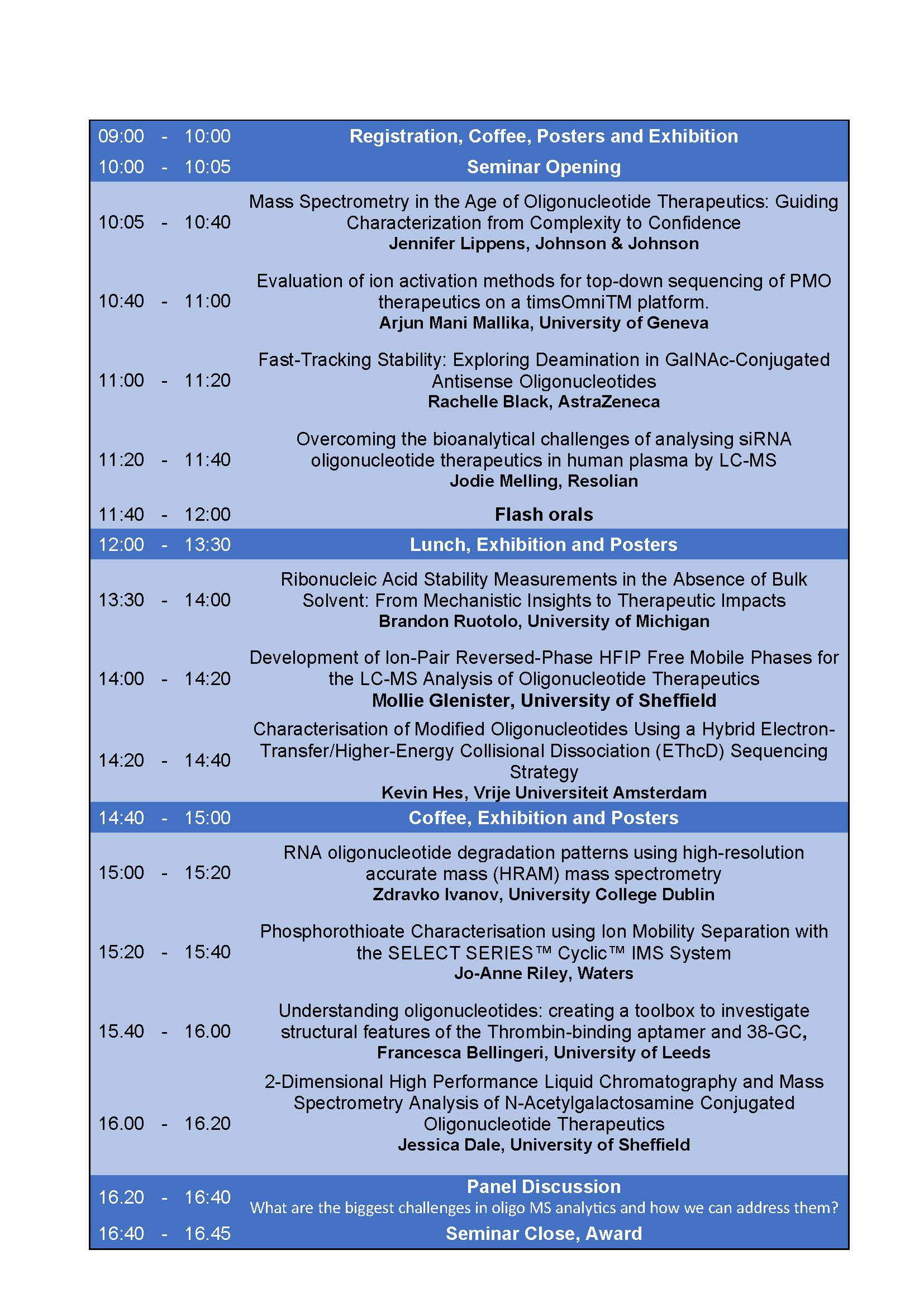


Scientific Programme

Invited Speakers:
Dr. Jennifer Lippens, Johnson & Johnson: 'Mass Spectrometry in the Age of Oligonucleotide Therapeutics: Guiding Characterization from Complexity to Confidence'
From the publication of DNA structure in 1953 to the approval and release of the first oligonucleotide therapeutic not even half a century later – the field of oligonucleotide therapeutics continues to be of extreme community interest. Throughout the relatively brief history of oligonucleotide therapeutics, mass spectrometry has emerged and continued to expand its utilization across multiple critical quality attributes, such as impurity characterization. Many synthetically produced oligonucleotides share similar modifications such as 2’-ribose modifications and modified backbones which aid in improved efficacy and/or safety but also add to the complexity of these already analytically challenging molecules. As the biopharmaceutical industry continues to develop new synthetic schemes and modifications in this rapidly evolving field, the potential for increasing molecular complexity continues to rise. Thus, this talk aims to take stock of the strides that mass spectrometry has made in its application across the diverse range of analytical challenges to date, while also generating some food for thought on the potential for mass spectrometry to grow in its application as this field continues to expand.
Prof. Brandon Ruotolo, University of Michigan: 'Ribonucleic Acid Stability Measurements in the Absence of Bulk Solvent: From Mechanistic Insights to Therapeutic Impacts'
Medicines of the future will rely heavily upon our ability to quickly assess the structures and stabilities of complex biomolecules and evaluate the influence of large libraries of conformationally-selective small molecule binders. In addition, the ever-growing and complex array of ribonucleic acid (RNA)-based biotherapeutics similarly demands improved tools that can rapidly detect changes in therapeutic structure upon target binding, alterations in formulation, or stress. Current structural biology tools lack the throughput and sensitivity to meet these challenges. In this presentation, I will discuss recent developments surrounding collision induced unfolding (CIU) methods that aim to bridge this technology gap. CIU uses ion mobility-mass spectrometry (IM-MS) to measure the stability and unfolding pathways of gas-phase RNAs, without the need for covalent labels or tagging, and consumes 10-100 times less sample than almost any other label-free technology. Recent developments in high-throughput CIU screening methods, their ability to track small alterations in structure over a wide array of model RNAs and therapeutics, as well as mechanistic insights into the CIU process, will be discussed.